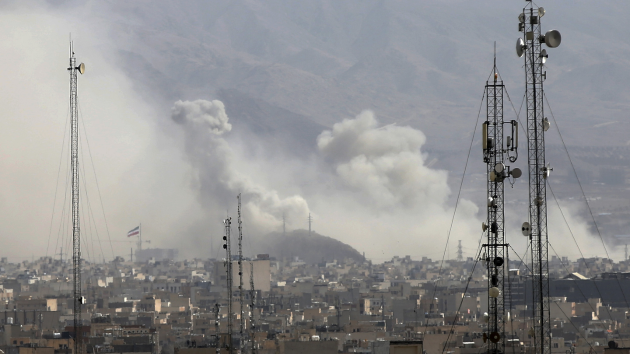
(NEW YORK) — Last summer, the United States struck several nuclear weapons facilities in Iran.
In the wake of the strikes, carried out by the highly advanced American B-2 bombers, President Donald Trump declared that the Iranian regime’s nuclear capabilities had been “obliterated.”
However, questions arose in the wake of the strikes about what was actually destroyed.
In the intervening months, the U.S. has tried to negotiate with the Iranian regime to reach a nuclear deal and Trump has repeatedly threatened the regime.
Recently, the administration began to float a potential strike, while maintaining that the nuclear program had been “obliterated,” leaving the justification for doing so unclear. In his address after Saturday’s strikes, Trump mentioned “imminent threats from the Iranian regime,” missile and nuclear capabilities as well as regime change.
Iran has stated numerous times that it doesn’t want nuclear weapons but believes it has the right to use nuclear power for civilian purpose.
A recent Defense Intelligence Agency memo suggested Iran was looking to develop an intercontinental ballistic missile by 2035, but Trump suggested missiles could be capable of reaching the U.S. “soon.”
Here’s how the events have unfolded.
June 12, 2025: Israel launches a series of preemptive strikes against Iran, hitting military targets including the nuclear program. A dayslong conflict erupts.
June 22, 2025: U.S. launches Operation Midnight Hammer, with more than 100 planes, including seven B-2 stealth bombers, targeting three nuclear sites in Iran. In the wake of the strike, Defense Secretary Pete Hegseth said the country’s nuclear ambitions were “obliterated.”
Hegseth said at the time that the scope of the operation was “intentionally limited” to give the Iranians a chance to negotiate and the attack was not about “regime change.” At the same time, Israel said that it struck “dozens of military sites” in Iran.
Trump floated the idea of regime change at the time writing on Truth Social – “It’s not politically correct to use the term, “Regime Change,” but if the current Iranian Regime is unable to MAKE IRAN GREAT AGAIN, why wouldn’t there be a Regime change???”
December 2025-January 2026: Protests break out in Iran that become widespread. The protests turn deadly, with the Human Rights Activists News Agency (HRANA) saying that thousands were killed. Trump threated to hit the regime “hard” if protesters were killed.
Jan. 26, 2026: Trump tells Axios that Iran “wants to make a deal.” “They were going to hang 837 people, and I told them, if you do it, you’re going to pay a price like nobody’s ever paid before. They pulled back. I appreciated that, but a lot of people have been killed. So, we’ll see what happens. I can say this. They do want to make a deal,” he said.
Jan. 28, 2026: Trump says on Truth Social that a “massive armada is heading to Iran” and “Hopefully Iran will quickly “Come to the Table” and negotiate a fair and equitable deal – NO NUCLEAR WEAPONS.” He further warned that “he next attack will be far worse” than Midnight Hammer.
Jan. 30: Trump says Iran wants to make a deal.
Feb. 3: A U.S. official confirms talks are tentatively scheduled to take place in Turkey.
Feb. 4: Secretary of State Marco Rubio says the U.S. is ready for Iran talks but “they will have to include certain things, and that includes the range of their ballistic missiles, that includes their sponsorship of terrorist organizations across the region, that includes a nuclear program, and that includes the treatment of their own people.”
Feb. 6: U.S. and Iran engage in indirect talks in Oman. After the talks, Iranian Foreign Minister Abbas Araghchi called them a “good start” according to state media.
Feb. 11: Vice President JD Vance says he wants a deal with Iran, but “if we can’t cut that deal, then there’s another option on the table.” He said regime change was “up to the Iranian people.”
Feb. 13: Trump says regime change is the “best thing that could happen.” He urged Iran to make a deal. “I will say they wanted to talk, but so far, they do a lot of talking, and no action,” he said.
Feb. 19: Trump gives Iran 15 days “maximum” to make a deal. “We’re either going to get a deal or it’s going to be unfortunate for them,” he said.
Feb. 24: During the State of the Union speech, Trump issued a stark warning to the Iranian regime. “They’ve already developed missiles that can threaten Europe and our bases overseas, and they’re working to build missiles that will soon reach the United States of America,” Trump said. Trump insisted that Iran would not agree to not pursue a nuclear weapon. He said “no nation should ever doubt America’s resolve.”
Feb. 26: The U.S. and Iran hold high stakes talks in Geneva. The administration said that it wanted a full stop to Iranian uranium enrichment. Secretary of State Marco Rubio said the regime posed a “threat” and “you can see them always trying to rebuild elements of” the nuclear program. Vance says there is “no chance” of a drawn out war.
Feb. 27: Trump says he is “not happy” with negotiations with Iran. “I’m not happy with the fact that they’re not willing to give us what we have to have.” But he said a final decision had not been made as to whether to strike. Earlier in the day, it was announced that Rubio would travel to Israel on Monday and Tuesday.
Feb. 28: The U.S. launches Operation Epic Fury, which Trump called “major combat operations” alongside Israel. Trump justified the attacks to “defend the American people by eliminating imminent threats from the Iranian regime.” He also called on the Iranian people to rise up and depose the regime. Trump has not provided evidence of the threats posed by Iran and did not seek the approval of Congress.
Copyright © 2026, ABC Audio. All rights reserved.