(NEW YORK) — With a busy travel season approaching, the Centers for Disease Control and Prevention is warning that additional measles cases in the U.S. can be expected over the next few months.
The agency sent the alert to state and local health departments, reminding them to report measles cases to the CDC within 24 hours and to have measles cases reported in hospitals and to public health authorities.
The CDC has encouraged public health departments to conduct contact tracing for exposed individuals as well as perform outreach to under-vaccinated communities.
“With continued measles transmission in areas across North America and expected increases in international and domestic travel and large events during spring and summer, additional measles cases are anticipated in the coming months,” the alert reads.
Parents should ensure they and their loved ones are protected against measles before traveling, the CDC says. This includes getting vaccinated against measles at least two weeks before leaving.
The measles, mumps and rubella (MMR) vaccine is typically given in two doses, the first at 12 to 15 months old and the second between ages four and six. One dose is 93% effective and two doses are 97% effective against measles, according to the CDC.
Those traveling to or living in an outbreak area may be eligible for an earlier vaccine between 6 and 11 months old, the CDC says. This additional shot would be followed by the typical two doses for a total of three doses.
After returning home from travel from an area with measles, travelers should look out for measles symptoms for three weeks and contact their doctor if they experience symptoms or think they may have been exposed, the CDC advises.
The alert comes as cases continue to be recorded across the U.S. So far this year, there have been 1,782 cases nationwide, according to CDC data.
Cases have been reported in 36 states: Alaska, Arizona, California, Colorado, Florida, Georgia, Idaho, Illinois, Kentucky, Louisiana, Maine, Maryland, Massachusetts, Michigan, Minnesota, Missouri, Montana, Nebraska, New Jersey, New Mexico, New York, North Carolina, North Dakota, Ohio, Oklahoma, Oregon, Pennsylvania, Rhode Island, South Carolina, South Dakota, Texas, Utah, Vermont, Virginia, Washington and Wisconsin.
About 92% of cases are among people who are unvaccinated or whose vaccination status is unknown, CDC data shows.
Meanwhile, 4% of cases are among those who have received just one dose of the MMR vaccine and 4% of cases are among those who received the recommended two doses, according to the CDC.
Last year, the U.S. recorded 2,288 measles cases, which is the highest number of national cases in 33 years, according to the CDC.
It also marked the first U.S. deaths recorded from measles in a decade, two among school-aged unvaccinated children in Texas and a third of an unvaccinated adult in New Mexico.
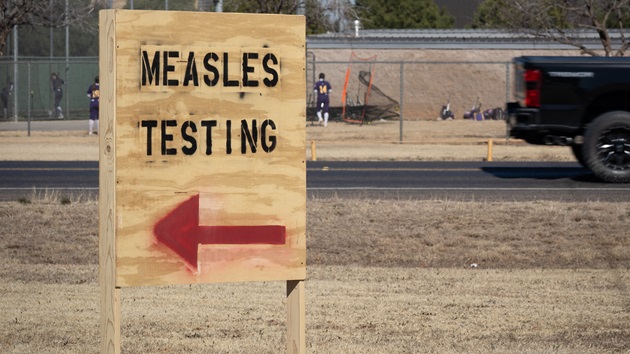
More than a year ago, health officials confirmed that cases of measles were cropping up in a small town in western Texas. It’s unclear if those cases are linked to those reported in other states; if so, it would mean the U.S. has seen a year of continuous transmission.
If it’s determined that the U.S. has experienced 12 months of continuous measles transmission, it could lead to a loss of the country’s elimination status that was earned in 2000. Measles would once again be considered endemic or constantly circulating.
Copyright © 2026, ABC Audio. All rights reserved.